
Venerable Sunjae appears on Culinary Class Wars!
I was genuinely shocked to see Venerable Sunjae on a popular Netflix cooking competition.

Adam and I had just come back from an outdoor swim in four-degree Celsius water and were chilled to the bone. As I moved around the kitchen to warm up, Adam scrolled through Netflix and landed on the second season of the Culinary Class Wars.
A few minutes in, Adam rather excitedly said “Venerable Sunjae is on this!” I laughed, telling him he must be confusing faces. But when I rewound the show, there she was! I messaged her immediately. She replied that she couldn’t say much as the show was still airing and that she was avoiding interviews.
Beyond the impressive dishes and commentary from the hosts – by Sung Anh, a former three-Michelin-star chef and Baek, Jong-won, a food entrepreneur – I found myself watching the show as both an insider and outsider to Korean culture. I also noticed subtle but telling dynamics between male and female chefs.
What struck me most was the prominence and size of the meat in many dishes. Amid plates featuring every type of animal protein, Venerable Sunjae showcased her vegan creations. Korea is small, and densely populated. Although South Korea has slightly more agricultural land than the North, it still cannot produce the food for its population (c. 49% self-sufficient).
As a country shaped by Japanese colonisation, and the Korean War in 20th century, and the ongoing risk of conflict, poverty and frugality were deeply ingrained during my childhood in the 1970s and 80s. We were taught never to leave any food behind – not even a grain of rice. Many dishes relied on bone broths topped with just a few slices of meat, a way to stretch flavour and make use of everything. I could count on one hand the number of times we ate meat in a month – until imported meat from the US made it suddenly cheaper and accessible in the 1990s as a part of the Uruguay Round, pushing smallholder farmers out of business.
Serving meat has been a symbol of prosperity and hospitality. When I left Korea in 2000, (Korean) BBQ restaurants were already booming, but when I went back, I found them in every other store. At one meal, I was shocked to see people leaving large chunks of meat and barely touched side dishes behind. When did Korea turn so wasteful? Is it a new symbol of prosperity? I wondered. For me, wasting food is not just about its methane statistics or the money and resources require to produce it - although these are critical concerns in a world of dwindling resources. It feels like a violation; the animals and plants gave their lives to sustain mine. The least I can do it to ensure that it serves the purpose.
I was secretly happy that a Temple Food Master I filmed with for three days, was appearing on a popular show, but many people asked me why a Buddhist nun would join a cooking competition for a prize. I had my suspicions, but I didn't want to misrepresent her intentions so I asked her!
She explained that her students learn so much through food in her classes: how ingredients are grown, how they affect the body, how they come together for flavour and nutrition, and how to appreciate them. She wanted to share that teaching with a wider audience through popular shows. It is unmistakably her!
She tells me that even younger generations now recognise her and that she recently filmed YouTube videos with one of the show’s hosts, Ahn, the former Michelin-starred chef.
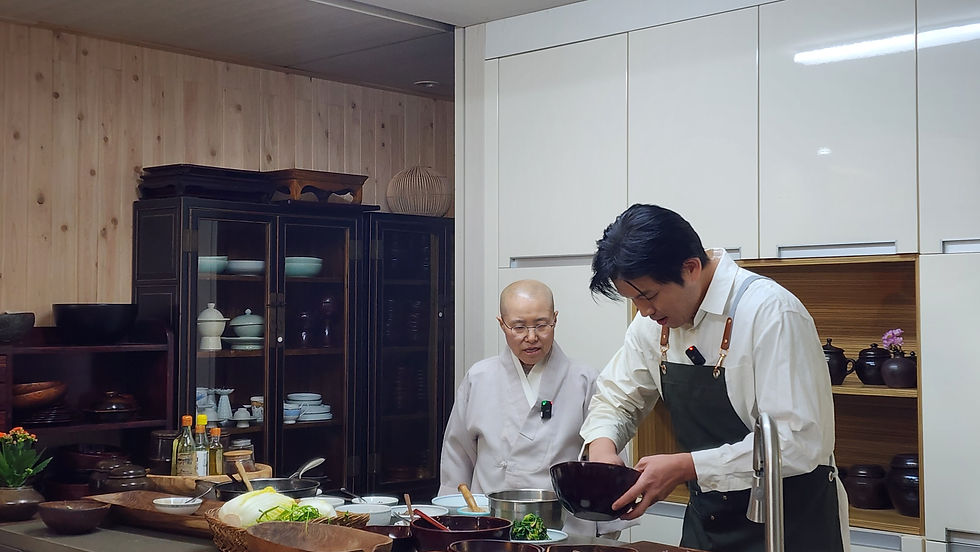
Venerable Sunjae with Chef Sung Anh at the Temple Food Research Center (aka her home kitchen), Image Credit: Venerable Sunjae.
Venerable Sunjae is not a nun who only meditates in temples and waits for disciples to visit. She engages fully with the world – through classes, seminars, cooking demonstrations, media appearances – sharing universal wisdom through food. This is reflected in Buddhist prayer said before every meal.
During the three days I spent filming with her, she told me that one does not need to be Buddhist to practice temple food. It is about mindset and practice, not religion – to help express the full potential of each ingredient, from growing to eating. She was, however, quite disappointed that I hadn’t given up meat.
I do the appreciation part really well, however: gratitude to nature, who knows how to create such delicious food; to farmers, who know how to work with that nature; to the network of distributors who know how to bring it to my kitchen; and to my husband Adam who can whip up delicious dish.

Venerable Sunjae giving cooking demonstrations and lectures at the Institute of Korean Royal Cuisine in Seoul
Watching the show made me want to return to Korea – to eat my way through the chefs’ restaurants featured on the show, and to spend time immersing myself in temple food training, despite my embarrassingly poor knife skills.
Better yet, I’ve been daydreaming about inviting her to the UK or Europe for events, so she could share her wisdom through simple, deeply nourishing, and delicious vegan dishes. Even with something as humble as a noodles, Venerable Sunjae knows how to combine ingredients to aid digestion, balance nutrition and bring out the best flavours.
In Western cooking, we often think about balancing flavour and nutrition, but rarely digestion. We accept indigestion as normal and reach for “the pink stuff”- or, in my case, apple cider vinegar.
Here is to a happy, healthy and abundant 2026!
Bumjoo xo


Comments